The European Commission is shifting from digital policy to an AI industrial policy
To contact us: editorial@fw.media


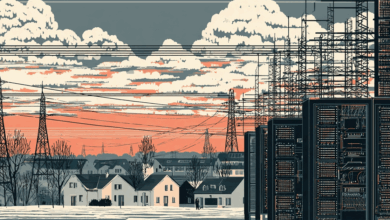
The global artificial intelligence race is now being fought through electricity grids, power-generation capacity, data infrastructure and industrial supply chains. With its new roadmap for digitalisation and artificial intelligence in the energy sector, published on 3 June, the European Commission is formalising a major shift in doctrine: AI is no longer regarded simply as a digital issue, but as a strategic industrial priority.
This represents a break with the way Brussels has approached artificial intelligence until now. Over the past decade, Europe’s efforts to build digital sovereignty have focused primarily on regulation. From the GDPR and the AI Act to the Data Act, the Data Governance Act and the Chips Act, the European Union has concentrated on setting the rules, protecting data, regulating uses and securing certain technological capabilities considered critical.
This approach has enabled Europe to become a regulatory power. It has not, however, answered a question that has become increasingly important: how can the material conditions required for a genuine European artificial intelligence industry be created?
The Commission’s answer is that AI must be understood as industrial infrastructure built on four pillars: energy, computing power, data and networks.
This new perspective directly follows the Draghi report on European competitiveness. The former President of the European Central Bank argued that regulation alone could no longer close the productivity gap between Europe and the United States. He called for an investment policy capable of supporting strategic technologies, energy and critical infrastructure. The roadmap published this week is one of the first operational applications of that vision.
AI is becoming a heavy industry
For several years, attention focused on models, algorithms and data. The debate revolved around the power of language models, their reasoning capabilities and the risks associated with their deployment. While that phase is not over, it is gradually being overtaken by a more fundamental reality: the availability of infrastructure.
Data centres currently account for approximately 2.5% of European electricity consumption. According to estimates cited by the Commission, their installed capacity could rise from 12 GW to nearly 28 GW by 2030.
This expansion comes as the electrification of the economy is accelerating under the combined effect of climate and industrial policies. Electric vehicles, heat pumps, electrolysers and certain industrial activities are already competing for limited grid-connection capacity in several European regions.
In this context, access to electricity is gradually becoming as important a competitive factor as access to talent or capital.
This shift brings artificial intelligence closer to industries traditionally regarded as strategic. Building a next-generation AI campus now requires investment on a scale comparable with some energy or industrial infrastructure projects. Its economics increasingly resemble those of a power plant or port terminal rather than those of a conventional software startup.
Europe joins the global battle for AI infrastructure
For several years, the United States and China have regarded artificial intelligence as a strategic industry requiring massive investment in physical infrastructure. Europe, by contrast, prioritised the construction of a regulatory framework intended to govern its use and protect citizens. This divergence now looks like a significant delay in an exceptionally fast-moving, high-growth global competition.
In the United States, investments announced over the past eighteen months amount to hundreds of billions of dollars. OpenAI, Oracle and SoftBank have launched Stargate. Microsoft, Amazon, Google and Meta are multiplying plans for energy campuses capable of powering tens of thousands of GPUs. Technology giants are negotiating directly with electricity producers, investing in nuclear power and securing energy supplies for decades.
China is following a comparable trajectory. Beijing has integrated artificial intelligence into its national industrial planning while simultaneously accelerating the deployment of power-generation capacity, computing centres and digital infrastructure. The objective is not simply to produce the best models, but to guarantee lasting access to the computing power required to develop them.
Faced with these two blocs, Europe risked becoming little more than a consumer market for technologies developed elsewhere. The Commission’s roadmap reflects a growing realisation: sovereignty in artificial intelligence depends as much on infrastructure as it does on algorithms. Whether this will be sufficient to accelerate Europe’s progress remains to be seen.
Data centres are acquiring a new status
This shift explains why the Commission devotes a significant part of its strategy to data centres.
The change is particularly evident in the status Brussels now assigns to them. Long regarded as privately owned infrastructure primarily managed by technology companies, data centres are now being recognised as strategic assets whose development must be coordinated with national and European energy policies.
The Commission is proposing tripartite agreements bringing together energy operators, public authorities and data-centre operators. It wants to encourage the use of long-term power purchase agreements, promote greater flexibility in electricity consumption and accelerate the recovery of waste heat for use in urban heating networks.
An underlying principle is emerging: data centres will no longer be able simply to connect to the grid and consume whatever electricity is available. They will also be expected to contribute to balancing the energy system.
This approach is directly informed by the difficulties already observed in several European regions. Around Dublin, Amsterdam and Frankfurt, the concentration of data centres is placing increasing pressure on electricity grids. Some connection requests now involve power requirements comparable with those of major industrial complexes. Brussels clearly wants to prevent these pressures from becoming an obstacle to the energy transition or European industrial competitiveness.
The return of European industrial policy
The strategy also marks the explicit return of European industrial policy. For several decades, the construction of the single market was based primarily on competition, market liberalisation and regulatory harmonisation. Major industrial programmes became relatively rare outside a small number of strategic sectors, such as aerospace and space.
Successive energy, geopolitical and technological crises have profoundly changed this approach.
The Chips Act for semiconductors, AI Factories for computing capacity and European projects in batteries and hydrogen already illustrate this shift. The energy and AI roadmap extends the same logic: certain infrastructures have become too strategically important to be left to market forces alone.
Electricity grids, data centres, cloud infrastructure, artificial intelligence models and energy data spaces must now be regarded as assets of sovereignty.
The emergence of European algorithmic sovereignty
For the first time, the Commission explicitly states that future artificial intelligence models used in the energy sector should be developed and controlled in Europe. The objective is to build specialised models capable of improving renewable-energy forecasting, congestion management, grid maintenance and investment planning.
This ambition reflects the emergence of a form of algorithmic sovereignty.
The goal is not to compete directly with the general-purpose models developed by OpenAI, Anthropic or Google. It is to ensure that the critical systems on which Europe’s future energy supply will depend are not controlled exclusively by companies outside the European Union.
The logic recalls the creation of Airbus in aerospace or Ariane in the space industry. The objective is not necessarily to dominate the entire global market, but to retain control over technologies considered essential to the continent’s strategic autonomy.
Energy data is becoming a strategic asset
Brussels believes that the current fragmentation of energy data represents a major obstacle to the development of innovative services and high-performing artificial intelligence models. Operators must still navigate different interfaces across member states, inconsistent access rules and varying levels of interoperability.
The Commission therefore wants to establish a framework that facilitates the exchange of energy data across Europe. Behind this technical objective lies a much broader ambition: to create a strategic European asset capable of supporting the development of future specialised AI models.
In a world where large models are trained on enormous volumes of data, Brussels clearly believes that European energy data could become a competitive advantage on the same level as computing infrastructure or electricity-generation capacity.
An AI-driven reindustrialisation strategy
The strategy also constitutes an implicit response to Europe’s growing technological lag.
The Commission notes that the United States produced 40 leading AI models in 2024, compared with only three in the European Union. This statistic illustrates a broader problem: Europe remains competitive in research but struggles to convert its scientific advances into industrial champions.
The document proposes addressing this weakness not simply by providing more funding to startups, but by creating an industrial environment conducive to the emergence of new sectors.
The objective is not only to produce Europe’s next AI champion. It is also to establish the conditions that will allow the entire European industrial base to use artificial intelligence to improve productivity, reduce energy costs and strengthen its competitiveness.
The use cases highlighted include electricity grids, nuclear power plants, renewable energy, buildings, mobility infrastructure and administrative permitting procedures. AI is being presented as a tool for transforming the economic infrastructure itself.
The real innovation in this roadmap is therefore not artificial intelligence. It is the recognition that the global AI race will not be won solely through the best models or researchers. It will depend just as heavily on the ability to build power plants, develop electricity grids, finance data centres, organise data sharing and secure critical infrastructure.
Europe no longer regards AI as just another digital sector. It is beginning to treat it as a strategic industry. Under this new model, electricity producers, grid operators, data-centre operators and developers of specialised models become components of the same industrial value chain. This is probably the most important change contained in the document.