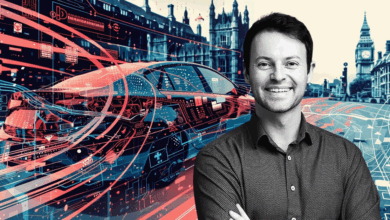
Embodied AI: Alex Kendall and Wayve bet on self-driving cars as physical AI’s first proving ground
To contact us: editorial@fw.media

Before turning to individual journeys, we want to look at innovation as a movement. Behind every technological or industrial transformation are different kinds of people: some venture into territories that remain uncertain; others build the organisations capable of turning those ideas into economic reality; and some redraw the rules of a market or trigger a shift that changes it for good.
Our new series, Architects of the Future, which will culminate in a book published at the end of the year, explores four ways of wielding the power to innovate. Each portrait goes beyond retracing a career. It seeks to identify the precise role a leader plays in shaping the dynamics of their time.
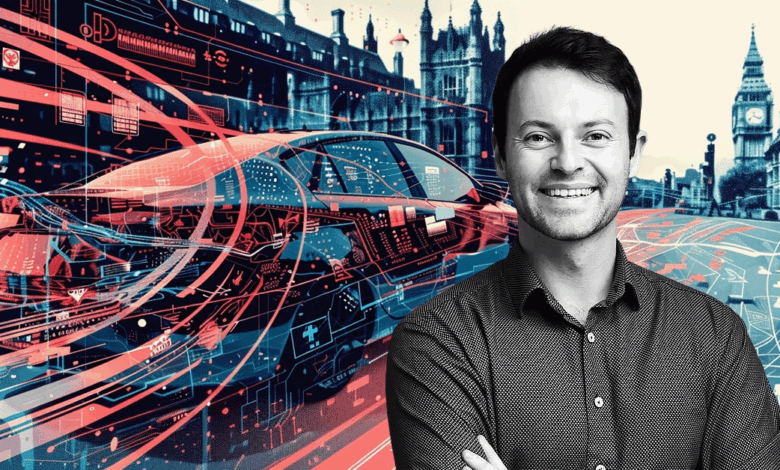
This is the lens through which we begin the first instalment, dedicated to Alex Kendall, founder of Wayve.
We first met him in 2018, after he won the pitch competition at Web Summit. Five years later, we encountered Alex Kendall again in the main auditorium of Cambridge’s Department of Engineering. At an institution where the histories of electricity, aeronautics and semiconductors have intersected for more than a century and a half, the engineer had returned to discuss a technological transformation still taking shape: embodied AI.
A decade earlier, he had sat in those same seats as a PhD student. Today, he leads Wayve, one of the most closely watched companies in autonomous driving, which has just completed a $1.2 billion funding round as it moves towards a potential IPO.
Artificial intelligence has already transformed how we produce text, search for information and automate certain cognitive tasks. For Alex Kendall, however, this first wave is merely a prelude.
The next stage will unfold through machines capable of perceiving their environment, understanding a scene and acting in the physical world. Many scientists and entrepreneurs are pursuing the same frontier, including Yann LeCun with AMI Labs, Figure AI founder Brett Adcock and Covariant founder Pieter Abbeel.
A childhood shaped by exploration
Alex Kendall likes to talk about “frontiers”. The word recurs throughout his story, whether he is discussing research, entrepreneurship or his childhood in New Zealand.
Growing up in the island nation proved decisive. New Zealand immersed him in a vast and sometimes unforgiving landscape where exploration is almost part of everyday life. From those years, he remembers team sports, the mountains and situations that demanded perseverance and curiosity. These experiences, he says, shaped the way he approaches technical problems.
Technology entered his life relatively early. By the end of secondary school, Kendall had already begun building a drone.
Looking back, he considers the project a defining moment. It taught him that some technologies can only emerge at the intersection of several disciplines. Building an autonomous system requires more than good software or a well-designed machine: the two must work together. Robotics and autonomous systems belong precisely to these hybrid territories, where artificial intelligence, electronics and mechanical engineering advance in concert.
A first encounter with Silicon Valley
Before Cambridge, Alex Kendall spent time in Silicon Valley. There, he discovered the startup world and helped develop a consumer drone capable of automatically filming its user while avoiding obstacles. The experience reinforced his conviction that technology only acquires meaning when it finds a place in a concrete use case.
California also gave him an early view of technology entrepreneurship. Its culture of rapid experimentation, acceptance of failure and focus on scale would leave a lasting mark on how he thought about innovation.
But it was an academic scholarship that truly changed the direction of his career and brought him to Cambridge, where he encountered an exceptionally dense scientific environment.
Cambridge becomes the laboratory for a new vision
When Kendall moved to the UK, he wanted to work on machine learning. He soon gravitated towards computer vision, a discipline central to any machine expected to operate in the physical world.
During his PhD, he helped develop SegNet, a deep-learning system designed to interpret images captured by a camera. The objective was to teach a machine to distinguish the different elements within a scene. Roads, cars, pedestrians, buildings and vegetation all had to be identified by the algorithm so the machine could understand its environment and act accordingly. The premise sounds simple. Its implementation is anything but.
The research extended beyond segmentation. Kendall and his team also explored depth, scene geometry, motion prediction and uncertainty estimation.
Through this work, he became convinced that machines could learn to understand the visual world and derive decisions from it. This intuition converged with another field of research that fascinated him at the time: agents learning within simulated environments, particularly at DeepMind.
For Kendall, bringing these two approaches together opened a new possibility: systems capable of learning complex behaviours without requiring every rule to be programmed by hand.
The Wayve bet
In 2017, Alex Kendall completed his PhD at Cambridge. A few months later, he founded Wayve with Amar Shah. Like many startups born in garages, its first prototypes were developed in modest surroundings, inside a house converted into a makeshift laboratory.
The company’s first experimental vehicle was a long way from the futuristic demonstrators now associated with autonomous driving. It was a small electric Renault Twizy covered in cameras. Inside, the two founders monitored image feeds and adjusted the algorithms controlling the system. On the streets of a medieval British city, the little car gradually began moving without human intervention. What was striking was not simply that it could drive itself, but that it did so without lidar, heavy infrastructure or reliance on pre-built maps.
Wayve’s founding idea was therefore to teach a car to drive from data, rather than explicitly coding every rule.
“From the very beginning, we built an end-to-end deep-learning system, a system that learns to drive from data,” Alex Kendall explains.
At the time, the approach attracted considerable scepticism. Most companies in the field favoured modular architectures based on high-definition maps, programmed rules and a large number of specialised sensors. Autonomous driving was conceived as a stack of software components: perception, localisation, planning and control.
Kendall and Shah, by contrast, sought to train a system capable of observing its environment, interpreting its signals and translating them directly into a driving decision. Their objective was not merely to operate a prototype within a controlled environment. It was to build a model capable of learning from its surroundings and adapting to them.
The early years were difficult. Gradually, however, the technology progressed. The first prototypes learned to follow a lane, then to navigate increasingly complex environments. Testing expanded from Cambridge to London, a decisive move that confronted the algorithms with dense urban traffic, cyclists, pedestrians and, above all, unpredictability.
In 2019, Wayve reached a significant milestone when one of its vehicles successfully navigated roads it had never encountered before. The ambition was no longer purely technical. It became industrial: to build a driving system general enough to be deployed at scale. Some of the first road trials were conducted with partner fleets, including those of supermarket group Ocado, which subsequently invested in the company.
From autonomous-driving startup to foundation model
Over time, Wayve evolved into a technology company pursuing an ambition broader than autonomous driving: building an embodied AI foundation model.
Its strategy is now to train a model capable of controlling different vehicles and learning from data generated by multiple fleets and, eventually, several carmakers. This is one of the key differences between Wayve and Tesla. Elon Musk’s company improves its system using data from its own fleet, while Wayve aims to sell its model to different automotive manufacturers, aggregating more diverse data across a greater number of markets. The company now works with several carmakers and mobility companies, including Uber and Nissan.
From this perspective, autonomous driving is not the destination but the first credible use case for embodied AI. Wayve describes its platform as hardware-agnostic, structurally independent of HD maps and designed not only for carmakers but, eventually, for robotics companies. Its work on LINGO and GAIA seeks to add multimodal and generative capabilities, including language-controlled interfaces, personalised driving styles and new forms of co-piloting.
Scaling financially and industrially
After an initial seed round, Wayve raised $20 million in 2019 to launch a pilot fleet in London. It followed with a $200 million Series B in January 2022, led by Eclipse Ventures.
In 2024, the company reached a new threshold with a $1.05 billion Series C led by SoftBank, with participation from Nvidia and Microsoft. The deal was the largest AI funding round ever completed in the UK and ranked among the largest globally in the sector. Yann LeCun was among the company’s earliest investors.
For Alex Kendall, the funding above all validated the intuition behind the first experiments with the Renault Twizy “and gives us the resources to turn this technology into a product and bring it to market”.
More recently, the startup raised another $1.2 billion at an $8.6 billion valuation. The round could reach $1.5 billion through an additional $300 million commitment from Uber, contingent on robotaxi deployments beginning in London. The deal places Wayve among Europe’s best-capitalised autonomous mobility companies.
Giving AI a body
For Alex Kendall, the history of artificial intelligence is only beginning. The first wave produced systems capable of writing text, answering questions and generating images. The next could mark a decisive step: giving those systems the ability to act in the physical world.
From this perspective, the self-driving car is only the first proving ground. At Wayve, the objective extends beyond automating driving. It is about training machines to perceive their environment, adapt to it and learn continuously through contact with the real world.
As the driver begins to disappear from behind the wheel, a deeper transformation is taking shape: the emergence of embodied artificial intelligence capable of operating across our cities, infrastructure and production lines.
The real challenge, in other words, is not merely to make machines more intelligent, but to give them a body. If that bet pays off, autonomous driving may ultimately be remembered as one of the first laboratories for a much broader transformation: artificial intelligence’s gradual entry into the physical world.