NEXT40 2026: Who are France’s new technological sovereignty champions?
To contact us: editorial@fw.media
For a decade, the success of French Tech was measured by the number of unicorns it produced, the amount of capital they raised and the ability of French startups to replicate the models that had made Silicon Valley successful. The emblematic companies were Doctolib, BlaBlaCar, Back Market, Mirakl and Contentsquare. Their common features were well known: digital platforms, software-based models, global markets and rapid growth.
The 2026 Next40 cohort tells a different story. Against a backdrop of a global race for artificial intelligence, tensions surrounding semiconductors, the return of industrial policy and the growing fragmentation of technology value chains, France appears to have changed its priorities. The companies highlighted this year are developing quantum computers, artificial intelligence models, biomaterials, batteries, exoskeletons, electric aircraft and innovative nuclear reactors. Behind the annual selection of French Tech champions lies a new definition of technological success: mastering capabilities considered strategic to the country’s economic autonomy.
The Next40 is no longer merely a growth ranking
The shift is first apparent in the selection criteria. For the first time, the programme explicitly identifies two pillars alongside economic performance: technological excellence and contributions to major economic and societal challenges. Companies must demonstrate their innovative credentials through patents, research programmes or participation in public innovation-support schemes. A dedicated selection committee has also been tasked with identifying companies whose development contributes to economic competitiveness, the public interest and improvements in citizens’ lives.
This change may appear technical, but it is fundamentally political. The “Startup Nation” era is over. The 2026 cohort is increasingly focused on identifying companies considered strategic for the coming decade. The objective is no longer merely to measure growth. It is also to direct attention towards the sectors France now regards as critical.
This development marks the return of a logic thought to have largely disappeared: that of the strategic state.
From unicorns to critical technologies
The shift is particularly visible in the composition of the Next40 itself. Several companies that shaped the French Tech narrative over the past decade remain on the list. Doctolib, Back Market, BlaBlaCar, Qonto and Contentsquare continue to embody France’s ability to create global digital leaders, but they are no longer at the heart of the story.
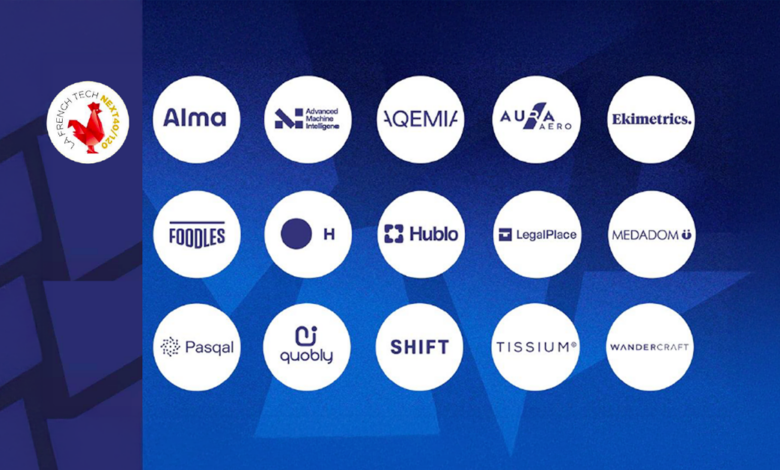
The 2026 cohort now highlights a new generation of companies. Artificial intelligence is represented by Mistral AI, H Company and AMI Labs. Quantum computing includes Alice & Bob, Pasqal and Quobly. In healthcare, Aqemia and Tissium illustrate the rise of technologies rooted in scientific research. Wandercraft represents French ambitions in advanced robotics, while Aura Aero symbolises emerging industrial strategies in aviation.
What these companies share is not merely growth, but control over technologies that are difficult to replicate and require years of research, highly qualified scientific teams and substantial investment. Where previous generations of startups built their competitive advantages through network effects, distribution or user experience, these new entrants are seeking to construct technological barriers. Nearly 40% of Next40 companies now come from the deeptech sector.
The return of industrial policy
This transformation extends far beyond the Next40. The prominence of France 2030 within the broader cohort is equally revealing: thirty-seven selected companies have received support through the programme. Several rank among the leading representatives of France’s national strategies in artificial intelligence, quantum computing, energy and healthcare.
After spending a decade developing an entrepreneurial ecosystem capable of competing with its European counterparts, the French state is now seeking to concentrate its efforts on the technologies it considers decisive for the next phase of global competition.
From software to factories
The 2026 cohort includes twenty-five companies with production facilities in France, representing thirty-three industrial sites across ten regions. These facilities produce batteries, biomaterials, photonic components, exoskeletons, nuclear reactors, space launch vehicles and electric aircraft.
The companies highlighted this year are following a very different trajectory. They are building laboratories, pilot lines, production centres and industrial infrastructure. Their development requires more capital, more time and greater industrial execution capabilities.
French Tech is no longer merely an innovation policy. It is gradually becoming a reindustrialisation policy.
The question left unanswered by the Next40
The technologies highlighted this year rank among the most capital-intensive in the modern economy. Quantum computing, artificial intelligence, batteries, robotics and nuclear power will require investments running into hundreds of millions, and sometimes billions, of euros.
France has considerably strengthened its early-stage funding capacity through Bpifrance and France 2030. The challenge over the coming years will be different: determining whether Europe has investors capable of supporting these companies until they reach global scale, or whether this stage will continue to depend primarily on international capital.
This is far from a secondary consideration. Technological sovereignty is not measured solely through patents, laboratories or factories, but also through the ability to finance the development of national champions independently.
A new definition of technological success
The 2026 Next40 cohort probably marks the end of a cycle that began with the emergence of France’s first unicorns. Success is no longer defined solely by a valuation or a record-breaking funding round. It is now associated with the ability to develop technologies considered critical to the country’s economic, industrial and digital autonomy.
Artificial intelligence, quantum computing, energy, healthcare, space and robotics: behind the forty companies selected this year, a new hierarchy of national priorities is taking shape. In short, the Next40 increasingly resembles not merely a ranking of startups, but a list of the technological bets France intends to win over the next decade.
| Company | Sector | Description |
|---|---|---|
| Alan | Insurtech / Healthtech | Digital health insurance for businesses and individuals. |
| Alice & Bob | Quantum computing | Develops quantum computers based on error-corrected qubits. |
| Alma | Fintech | Instalment-payment solution for merchants. |
| AMI Labs | Artificial intelligence | Develops AI models capable of understanding the physical world. |
| Aqemia | Healthtech / AI | Uses artificial intelligence and molecular physics to discover new medicines. |
| Aura Aero | Aviation | Develops electric and hybrid regional aircraft. |
| Back Market | Recommerce | Global marketplace for refurbished electronic products. |
| BlaBlaCar | Mobility | Carpooling and shared-transport platform. |
| ChapsVision | Data & AI | Data-analysis software and sovereign AI agents for companies and public authorities. |
| Contentsquare | Martech | Analyses the user experience across websites and applications. |
| Descartes Underwriting | Insurtech | Parametric insurance and climate-risk modelling. |
| Doctolib | Healthtech | Appointment-booking platform and software for healthcare professionals. |
| EcoVadis | ESG / SaaS | Assesses the sustainability performance of companies and suppliers. |
| Ekimetrics | Data & AI | Data science and artificial intelligence consulting for large companies. |
| Electra | Electric mobility | Fast-charging network for electric vehicles. |
| Exotec | Robotics | Warehouse automation using logistics robots. |
| Flying Whales | Aviation | Develops high-capacity cargo airships. |
| Foodles | Foodtech | Workplace catering based on connected refrigerators. |
| H Company | Artificial intelligence | Develops autonomous AI agents for businesses. |
| Hublo | Healthcare HR | Management of hospital staffing and shift replacements. |
| Innovafeed | Agritech | Produces insect proteins for animal and plant nutrition. |
| Ledger | Crypto / Cybersecurity | Security solutions for digital assets. |
| LegalPlace | Legaltech | Online company formation and administrative management. |
| Malt | Future of Work | Platform connecting companies with freelancers. |
| Medadom | Healthtech | Medical teleconsultations and connected healthcare booths. |
| Mistral AI | Artificial intelligence | Develops sovereign, open-weight generative AI models. |
| NW | Energy Tech | Energy-storage and power-grid management solutions. |
| Pasqal | Quantum computing | Develops neutral-atom quantum computers. |
| PayFit | HR Tech | SaaS payroll and human-resources management. |
| Pennylane | Fintech | Financial and accounting management platform for SMEs. |
| Pigment | Financial SaaS | Financial planning and budgeting software. |
| Qonto | Fintech | Banking and financial management for small businesses and SMEs. |
| Quobly | Quantum computing | Develops quantum processors compatible with existing industrial manufacturing processes. |
| Shift Technology | Insurtech / AI | Fraud detection and automation for insurers. |
| Spendesk | Fintech | Corporate expense and procurement management. |
| Swile | HR Tech / Fintech | Employee benefits and business payments. |
| Tissium | Medtech | Develops biological polymers for repairing human tissue. |
| Verkor | Energy Tech | Manufactures batteries for electric vehicles. |
| Voodoo | Gaming | Global publisher of mobile games and consumer applications. |
| Wandercraft | Robotics | Develops exoskeletons and industrial humanoid robots. |
To discover the 2026 French Tech 120 cohort, click here.