RHINE GROUP: Mario Draghi and Patrick Collison want to build the coalition Europe is missing
To contact us: editorial@fw.media

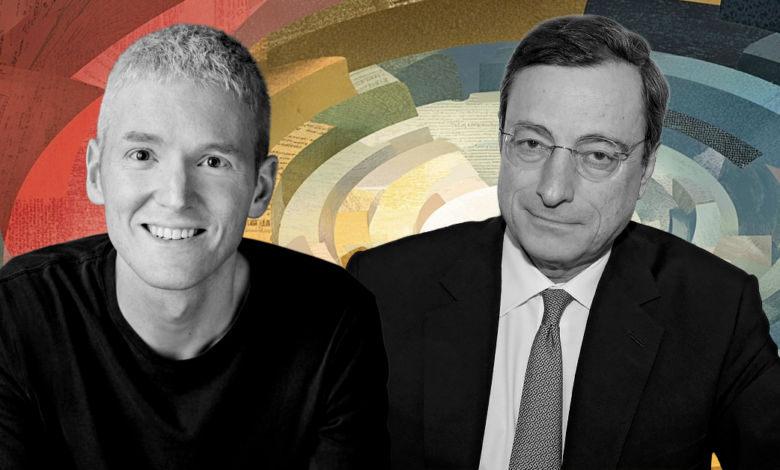
Two years after laying out his diagnosis of Europe’s economic decline, Mario Draghi is changing his method. Together with Stripe co-founder Patrick Collison, the former ECB president is launching Rhine Group, an independent organisation bringing together economists, entrepreneurs, investors, former public officials and media executives. The ambition is no longer simply to explain what Europe should do, but to bring together the people capable of turning recommendations into decisions. It is a bet that immediately runs into its own limitation: Europe’s blockages are not only the result of poor coordination, but of very real economic and political divergences between governments, companies and citizens.
A diagnosis that has become the official vocabulary
In September 2024, Mario Draghi delivered to the European Commission one of the starkest assessments of the continent’s economy since the creation of the single market: insufficient productivity, excessively high energy costs, fragmented capital markets, technological underperformance, difficulties turning research into global companies, and chronic underinvestment. The report concluded that the gap with the United States could no longer be closed without a profound transformation of Europe’s economic model.
Two years later, much of that vocabulary has become embedded in Brussels. The Commission has launched its Competitiveness Compass, a strategy for startups and scaleups, the Clean Industrial Deal, and several investment programmes in artificial intelligence, defence and critical technologies. In September 2025, it said that 90% of the flagship initiatives in its Competitiveness Compass were directly inspired by recommendations from the Draghi report.
The problem is therefore no longer intellectual agreement with the diagnosis, but implementation. In July 2026, the Draghi Implementation Index developed by EPIC considered only 60 of the 383 recommendations it tracks to have been fully implemented, or 15.7%. That rises to 41.3% when partially implemented measures are included. Institut Montaigne, which uses a different methodology covering 567 recommendations, reaches an equally severe conclusion: much of the work remains unfinished.
It is in this gap between diagnosis and decision that Mario Draghi now intends to intervene.
After the report, build the coalition
Launched in August 2026, Rhine Group does not present itself as yet another European institution. The independent organisation is operationally led by Luis Garicano, professor at the London School of Economics and a former member of the European Parliament.
Its mission is to bring together leaders from business, public policy and research to turn data and economic analysis into action. Discussions will be based on research prepared in advance and held under the Chatham House Rule, allowing participants to use the information shared without publicly attributing it to individual speakers.
According to Luis Garicano, the objective is now to prioritise the Draghi agenda and facilitate the implementation of reforms, with documents to be published following the group’s first meetings. “The reform agenda is very paralysed,” he told El País.
The change in method is significant. The Draghi report followed a linear sequence: diagnosis, then recommendations. Rhine Group adds several intermediate stages: diagnosis, prioritisation, consensus, coalition, decision.
The organisation has no regulatory power, no European budget and no parliamentary majority. Its potential value lies in reducing friction between those who design reforms, those expected to finance them, and those who understand the constraints involved in implementing them. Its ultimate product may therefore be less a new report than a sufficiently robust consensus to make certain decisions politically possible.
Patrick Collison, or Draghi’s new method
Patrick Collison’s presence alongside Mario Draghi is probably the most revealing aspect of the project. The pairing is far from obvious: Draghi, 78, comes from the world of central banks, government and European institutions; Patrick Collison, 37, built with his brother John one of the most important payment infrastructures in the global digital economy. One has spent decades working on the macroeconomic conditions for growth; the other has experienced first-hand what it takes to build a technology company at global scale.
Patrick Collison has long been involved in debates about science, innovation and the institutions capable of accelerating progress. He notably co-founded the Arc Institute, which funds long-term biomedical research programmes — a dimension Rhine Group explicitly highlights. Together with economist Tyler Cowen, he also helped popularise Progress Studies, a field that seeks to understand why some societies produce more discoveries, infrastructure, companies and economic growth than others.
His involvement alongside Draghi can therefore be seen as the meeting of two approaches: one examines the causes of Europe’s economic decline, while the other comes from the system that has produced many of the technology companies against which Europe measures itself. Rhine Group wants to bring these two perspectives into conversation.
Importing an American mechanism for building consensus
The institutional model is not entirely European. According to El País, Rhine Group draws inspiration from the Aspen Economic Strategy Group, created in the United States around former Treasury secretaries, economists and business leaders to produce evidence-based proposals and create spaces for discussion between policymakers from different political backgrounds.
The parallel is all the more striking because Patrick Collison joined the Aspen Economic Strategy Group in February 2026, alongside figures including Gita Gopinath, Peter Orszag and Evan Spiegel. The group is co-chaired by former Treasury secretaries Henry Paulson and Timothy Geithner.
This architecture responds to a specifically European problem. The United States has numerous places and networks where Washington, Wall Street, Silicon Valley and the country’s leading universities intersect. These networks do not eliminate American political conflicts, but they facilitate the circulation of people, capital and ideas between research, business and government.
Europe has the same capabilities, but they are dispersed. Brussels concentrates part of the continent’s regulatory power, Frankfurt its monetary policy; Paris, Berlin, Rome, Madrid and Warsaw retain most of the budgetary and industrial power; London remains one of Europe’s major financial centres despite having left the European Union; and its technology hubs are themselves fragmented across several countries. Rhine Group is attempting to institutionally create what Europe’s geography does not naturally produce: a permanent network connecting capital, technology, research and political power.
Bringing together the entire policy-making chain
The composition of the group confirms this ambition. Alongside Draghi, Collison and Garicano are economists including Philippe Aghion, Pierre-Olivier Gourinchas, Lucrezia Reichlin, Beatrice Weder di Mauro, John Van Reenen and Francesco Giavazzi; technology founders and executives including Tobi Lütke of Shopify, Sebastian Siemiatkowski of Klarna, Bastian Nominacher of Celonis, Luca Ferrari of Bending Spoons, Xavier Niel and Niklas Zennström; figures from finance and investment; as well as former public officials including Bruno Le Maire, Benoît Cœuré, Vittorio Colao, Jörg Kukies and former Estonian president Toomas Hendrik Ilves. Roula Khalaf of the Financial Times, Zanny Minton Beddoes of The Economist and Louis Dreyfus of Groupe Le Monde complete the group.
The aim is therefore not simply to bring together economic experts, but to connect several stages in the production of economic policy: researchers establish the diagnosis, entrepreneurs confront it with operational reality, investors question how it can be financed, former public officials assess its political feasibility, and the media help circulate those ideas through the public debate.
The missing coalition may not be entirely in the room
While Rhine Group is remarkably successful at assembling those who design public policy, run large companies and allocate capital, it is less representative of those who will have to bear, negotiate or accept the consequences of reform. Trade unions, employee organisations, consumer groups, local authorities and SME representatives are far less visible in the group’s current composition. National politicians who remain directly accountable to voters are also much less present than former ministers and former institutional officials.
This is not an issue of symbolic representation, but of political economy. The recommendations in the Draghi report are not neutral: consolidating certain markets may create more powerful companies while reducing the number of competitors; changing the mechanisms through which the economy is financed may redistribute power between banks, financial centres and institutional investors; reforming the energy market inevitably creates winners and losers across industries and regions; deepening the single market requires some governments to give up national rules they regard as instruments of economic policy.
A reform can therefore be optimal at the European level without being politically optimal for every actor required to adopt it. This is where the first limitation of the Rhine Group model emerges: consensus among experts, executives and investors does not automatically produce the political consent required for reform. Bringing together those who understand why a decision is necessary is not the same as bringing together those whose agreement will make that decision possible.
European governments are not blocking one another simply because they fail to communicate
The second difficulty is even more fundamental. Rhine Group implicitly rests on the idea that better-quality discussion, informed by research and organised among experienced actors, can unlock certain reforms. That is probably true when the blockage stems from a lack of information, poor coordination or regulations designed independently of one another. But a significant share of Europe’s fragmentation is not merely dysfunctional. It reflects divergent economic interests.
Every country may want a more efficient capital markets union without agreeing on where financial activities and their supervision should be concentrated. All may want cheaper energy while starting from different energy mixes, infrastructure and industrial interests. All want to strengthen Europe’s defence industry while protecting their own manufacturers, jobs, technologies and supplier networks. All call for more European champions, but every government naturally prefers to see their factories, R&D centres and headquarters located within its own borders.
European fragmentation is therefore not always an institutional bug. Sometimes it is the perfectly rational expression of 27 different national interest functions.
The distinction matters. When a problem results from insufficient coordination, more dialogue may be enough. When interests conflict, something else is required: negotiation, compensation, redistribution of gains and acceptance of power struggles. This is where Rhine Group will have to prove that it can move from manufacturing consensus to manufacturing compromise.
Competitiveness is becoming a question of sovereignty
The project reflects a broader evolution in European economic doctrine. Rhine Group begins from the observation that the environment which allowed the continent to prosper for several decades has deteriorated: international trade has become less predictable, the United States has hardened its trade policy, China is exerting growing pressure on European markets, and dependencies in energy, technology and industry have become strategic vulnerabilities. The group also points out that only four of the world’s 50 largest technology companies are European — a figure it uses to illustrate the continent’s difficulty in turning its research base and single market into global technology giants.
But the argument extends beyond technology. For Draghi and Collison, economic stagnation ultimately reduces Europe’s ability to finance its defence, healthcare systems, pensions, education, climate transition and social protection. Competitiveness is therefore no longer one economic policy among others: it becomes the material precondition for all of them. The chain is straightforward: productivity, growth, investment capacity, state power. Under this interpretation, European sovereignty does not begin with export controls, defence programmes or industrial policy. It begins with the capacity to generate enough wealth to finance them.
From “protect” to “build”
Rhine Group’s vocabulary also reflects a change in doctrine. Faced with the risk of economic decline, the organisation does not merely propose stronger protections for the European economy: its manifesto calls on Europe to start again to “compete, build, and grow.”
The shift is significant. Part of Europe’s response to recent geopolitical shocks has centred on reducing dependencies: regulating, protecting, securing supply chains, screening investments and subsidising certain critical capabilities. Rhine Group asks a different question: how can Europe once again produce enough companies, technologies and infrastructure that it no longer has to manage those dependencies in the first place?
This is where Collison becomes Draghi’s natural complement. The challenge is not only to defend existing European companies but to create the conditions in which the next generation can reach global scale — otherwise Europe risks confusing a policy for scale with a policy for protecting incumbents. Creating champions only produces lasting value if the conditions remain in place for new entrants to challenge them. Europe will therefore have to resolve another tension: building larger companies without turning competitiveness policy into a mechanism for protecting established players.
The real test will begin when someone has to lose
Rhine Group is only just getting started. Its first proposals will reveal which battles Draghi, Collison and Garicano actually intend to prioritise. The single market, capital markets integration, energy, scaleup financing and regulatory simplification are among the obvious candidates given the priorities laid out in the Draghi report.
But the group’s success will not be measured by its ability to produce another set of recommendations. Europe already has hundreds of pages explaining what it should change. The real test will come when a proposal genuinely requires a government, an industry or a category of stakeholders to give up an existing advantage in exchange for a broader European benefit. That is precisely where politics begins.
In 2024, Mario Draghi succeeded in establishing a diagnosis: without greater investment, productivity and innovation, Europe risks a gradual decline in both its economic weight and its strategic capacity. In 2026, Rhine Group is attempting to take the next step by bringing together those who can turn that diagnosis into a programme for action.