The day Silicon Valley realized it wasn’t sovereign
To contact us: editorial@fw.media

Since last Friday, the ban on Anthropic’s Mythos and Fable models has fuelled debate over European digital sovereignty. Reactions have centred on the same concern: what would happen if the United States one day decided to cut off access to certain artificial intelligence technologies?
The question is legitimate, but it may be missing the point. The most significant development in this episode is not that Europe has discovered its dependence on American laboratories. It is that American laboratories are discovering their own dependence on Washington.
OpenAI, Anthropic and Google DeepMind are now perceived as the new power centres of the global economy, capable of directing capital flows, reshaping industrial value chains and transforming entire sectors of economic activity. Yet Washington’s decision is a reminder of a truth Silicon Valley had begun to forget: when a technology becomes an instrument of national power, engineers no longer have the final say.
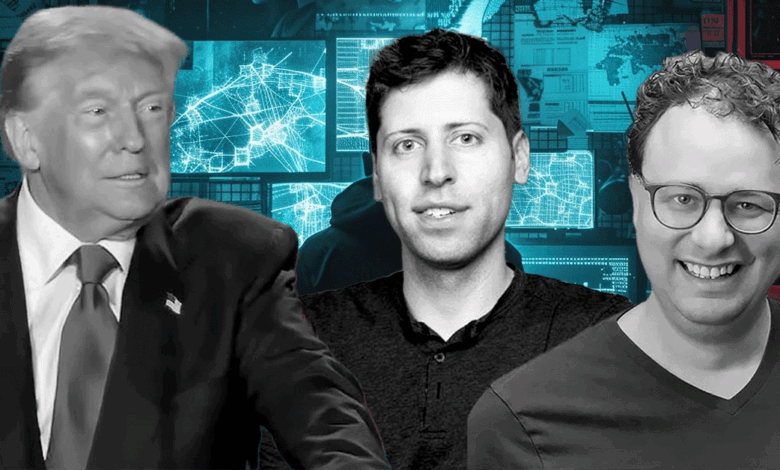
At the G7 summit in Évian, Dario Amodei, Sam Altman and Demis Hassabis staged an unprecedented display. They were not merely defending global access to artificial intelligence. Above all, they were defending the fundamental assumption underpinning their valuations: the certainty that no one can suddenly close off the markets on which their growth depends.
Anthropic is probably only the first domino.
The defining event is not that one laboratory has been sanctioned, but that Washington has demonstrated its willingness to intervene directly in the global distribution of the most advanced models. The issue therefore extends far beyond Anthropic. It concerns OpenAI, Google DeepMind and xAI, as well as any future laboratory whose growth rests on an assumption that had become almost invisible because it seemed so firmly established: the free global circulation of AI models.
For the past three years, investors have valued artificial intelligence as a global industry. Models cross borders at the speed of light. Users number in the hundreds of millions. Addressable markets are measured on a planetary scale.
For companies valued at several hundred billion dollars, this risk undermines their financial models, and it could hardly have emerged at a worse time.
Why Amodei, Altman and Hassabis are now speaking with one voice
The G7 summit offered an unusual spectacle. Dario Amodei, Sam Altman and Demis Hassabis delivered remarkably similar messages: cooperation among democracies, common standards, international coordination and the sharing of cybersecurity capabilities. The leaders of the world’s three most influential AI laboratories had suddenly adopted the same language.
This alliance of circumstance is anything but insignificant. Anthropic and OpenAI compete for the same customers, researchers and investment. DeepMind is pursuing the same technological ambition. Yet when facing Washington, those rivalries appear to have been temporarily set aside.
Their business models cannot withstand a kill switch. AI’s future revenues depend on a global market. The colossal investments being made in data centres, GPUs and training infrastructure assume that models will be distributed worldwide. The moment that assumption becomes uncertain, the financial equations begin to change.
It is not difficult to understand that behind these appeals for international cooperation lies a far more practical concern: preserving the conditions that justify the industry’s current valuations.
Hyperscalers have even more to lose
One aspect has been largely absent from the current debate: the hyperscalers may be the most exposed players of all.
AI has become the primary growth engine for cloud infrastructure. Microsoft is building data centres at an unprecedented pace to support OpenAI. Amazon is multiplying its investments in AI capacity for its cloud business. Google is justifying a growing share of its infrastructure spending through the training and inference requirements of AI models.
Behind every model lies a far broader value chain, into which hundreds of billions of dollars have been committed on the basis of a single conviction: global demand for AI will continue to grow without encountering any major obstacles.
If models become subject to authorisation regimes, controls or geopolitical restrictions, however, this entire system could be affected. The laboratories sell the models; the hyperscalers sell the motorway on which those models travel.
The economic impact could be catastrophic for an entire ecosystem which, more than a bubble, resembles…
Silicon Valley is discovering the risk it helped create
The irony deserves to be noted. For more than a decade, America’s largest technology companies have supported the idea that certain technologies must be protected on national security grounds.
Huawei was progressively excluded from numerous Western markets. Exports of advanced semiconductors to China were restricted. Critical infrastructure became a strategic concern, while export controls multiplied with the aim of preserving America’s technological lead.
Those same mechanisms are now being imposed on America’s own champions. Silicon Valley is discovering that it is no longer entirely in control of its destiny, and that Donald Trump is prepared to keep raising the pressure.