
Who will pay for AI’s gigawatts?
To contact us: editorial@fw.media

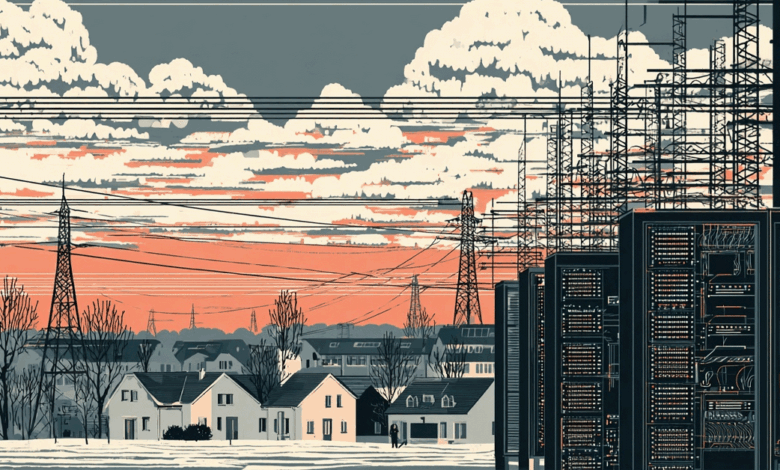
Artificial intelligence is often presented as a race between models. OpenAI, Anthropic, Google, Meta and Mistral AI compete through benchmarks, reasoning capabilities and billions of parameters. Yet behind this contest lies another battle, one taking place not in laboratories or research centres, but across electricity grids, transformer substations and the trading desks of infrastructure funds.
The AI economy is entering a new phase. After the race for data and then GPUs comes the race for gigawatts.
This development is fundamentally changing the nature of the sector. For more than 20 years, the digital economy prospered on an implicit assumption: electricity was readily available and abundant. Infrastructure was a secondary concern compared with software. AI reverses that logic. Every technological advance requires more computing power, more servers and more energy. The limits are no longer merely algorithmic. They are becoming physical.
According to the International Energy Agency, data centres consumed approximately 460 TWh of electricity worldwide in 2024. Driven by generative AI, that figure could exceed 1,000 TWh before the end of the decade. For comparison, this would represent more electricity than Japan consumes today.
This dynamic is already visible among hyperscalers. Meta plans to invest between $125 billion and $145 billion in AI infrastructure in 2026. Microsoft could allocate between $115 billion and $135 billion to its computing and cloud capacity. Alphabet is following a similar trajectory, with an investment programme of approximately $80 billion. Behind these figures are computing campuses whose energy requirements now reach several hundred megawatts.
The Stargate project in the United States illustrates this change in scale. Its ambition is to develop several gigawatts of computing capacity dedicated to artificial intelligence. At that level, a data centre becomes an energy consumer comparable to a major city or a large industrial complex.
This expansion is revealing a new form of scarcity. Over the past two years, the industry has focused on advanced semiconductors and NVIDIA GPUs. Many companies are now gradually discovering that the real bottleneck may be access to energy.
Capital may be available, but securing several hundred megawatts of grid-connected capacity within a timeframe compatible with the ambitions of AI companies is becoming increasingly difficult. In some regions, connection times already extend over several years.
This reality is now entering regulatory debates. Mississippi has become one of the first laboratories for this new AI energy economy. The state has attracted several AWS projects representing more than $13 billion in announced investment. To support this growth, utility Entergy is developing new generating capacity, including three gas-fired power plants with a combined installed capacity of more than 2,200 MW. The estimated cost of this infrastructure exceeds $3.8 billion.
A report published by Synapse Energy Economics estimates that residential customers may already have contributed approximately $38 million towards infrastructure investments associated with these new data centres, with the figure potentially reaching $74 million by the end of 2026. Above all, the authors emphasise that it is impossible to verify precisely how the costs are being allocated because the contracts between large electricity consumers and the utility remain confidential.
Mississippi is not an isolated case. Several US states are beginning to create specific tariff classes for very large electricity consumers. Virginia, Ohio, Kansas and Pennsylvania are working on mechanisms requiring long-term commitments, financial guarantees or minimum consumption levels to prevent infrastructure costs from being transferred to other grid users.
Europe has not yet opened this debate with the same intensity. The same tensions, however, are gradually emerging.
France aims to become one of Europe’s leading AI hubs. Project announcements are multiplying around Mistral AI, Data4, OpCore and consortia backed by international investors. The country enjoys a clear comparative advantage: largely decarbonised and relatively abundant electricity generated by its nuclear fleet. Yet that abundance becomes less obvious when several hundred megawatts must be connected within a single region.
The issue is not confined to data centres. The automotive industry needs more electricity for its gigafactories, while hydrogen producers are seeking to secure substantial capacity. Decarbonising heavy industry will also require massive electrification. Transport and residential uses are moving in the same direction. For the first time in several decades, multiple public policies are converging on the same resource: electricity.
The question is therefore becoming less technological than industrial. Every gigawatt allocated to an AI campus is a gigawatt that will not be immediately available for another purpose. The debate over financing is gradually giving way to a new question: which uses should take priority when electricity capacity is allocated?
This development is also transforming the role of hyperscalers. AWS, Microsoft, Google and Meta are no longer merely technology companies. Their investment decisions now influence the energy strategies of entire regions. Like the major steel and automotive groups of the previous century, they are becoming powerful enough to shape investment in electricity grids and the economic development of entire territories.
Another participant is emerging within this equation: infrastructure funds. Brookfield, BlackRock, KKR, Macquarie, Global Infrastructure Partners and Gulf sovereign wealth funds are investing heavily in data centres, electricity grids, energy infrastructure and generating capacity. AI is creating a new market for patient capital. The infrastructure required for its expansion will be depreciated over 20, 30 or 40 years, while the models themselves evolve every six months.
This paradox is perhaps one of the most revealing features of the current period: the fastest-moving technology industry in history now depends on the slowest infrastructure to build.
The question “Who will pay for AI’s gigawatts?” therefore has no single answer. Consumers, hyperscalers, grid operators, infrastructure investors and public authorities will all contribute, in one form or another, to financing this new layer of infrastructure.
The real question is who will decide how that capacity is allocated. Which projects will be considered priorities? What place does Europe want to give AI relative to reindustrialisation, transport and the energy transition?
For two years, the AI industry has been dominated by the battle between models. The next decade may be defined by the battle over infrastructure. In this new economy, the decisive factor may no longer be the quality of the algorithms, but the ability to secure gigawatts over the long term.