
AT VIVATECH, four visions of the future clashed
To contact us: editorial@fw.media

If there was one thing entrepreneurs, investors, and researchers at VivaTech 2026 seemed to share this year, it was a certain fatigue with AI washing
It was spilling over from everywhere — artificial intelligence was everywhere: on the booths, in the pitches, in the press releases, in the institutional speeches. At times it became hard to tell what represented a genuine technological breakthrough from what simply amounted to slapping the letters “AI” onto an existing product.
As artificial intelligence becomes ubiquitous, it paradoxically stops being a differentiator. That’s probably why the real subject of VivaTech 2026 wasn’t artificial intelligence — or more precisely, it wasn’t AI itself.
What emerged in the aisles of Hall 7, in conversations among investors, in the most crowded demos, and in the most strategic talks, told a different story. The projects that grabbed attention were about robots, energy infrastructure, semiconductors, quantum computing, health, space, and new industrial architectures.
As if artificial intelligence were gradually disappearing into the technological landscape — not because it’s losing importance, but because it’s becoming a commodity.
The same thing happened with the internet: in the mid-1990s, the network itself was the main topic. A few years later, nobody visited a company just because it used the internet anymore — what mattered was what it built with it. Artificial intelligence is entering a comparable phase.
At VivaTech, then, the most interesting things weren’t always where all eyes were focused, but showed up quietly in the humanoid robot demos from Agibot and Unitree, in the space ambitions of Blue Origin and The Exploration Company, in Nyobolt’s batteries, in the quantum systems from IBM and Pasqal, in Blueprint Biomed’s medical implants, or in Alithea Biotechnology’s drug-discovery platforms.
Over the course of four days, another reading of the event gradually took shape: VivaTech wasn’t simply describing emerging technologies — it was mapping out the global balance of technological power.
Four visions of the future under one roof
The booths of Meta, Alibaba, Mistral AI, Unitree, Pasqal, and Samsung have nothing in common — and yet each one tells a different story about the future.
The United States continues to dominate the most profitable layers of the digital economy. Talks from Amazon, OpenAI, NVIDIA, Meta, and Google revolved around foundation models, compute, cloud infrastructure, and future human-machine interfaces. When Jeff Bezos talks about the Moon, when Amazon unveils its specialized chips, or when Meta continues experimenting with smart glasses, it’s not just innovation — it’s about controlling tomorrow’s technology distribution layers.
China tells a different story.
Unitree’s humanoid robots were probably one of the most photographed attractions at the show. Yet their interest doesn’t lie solely in their technical performance. China’s show of strength rests less on isolated innovation than on execution capability. Massive access to robotics data, integration of the industrial supply chain, control over manufacturing costs, speed of industrialization: in certain fields, particularly embodied robotics, China is no longer trying to catch up with the United States or Europe — it’s already building a structural advantage.
Europe is following a different trajectory. The many French Tech booths, and the sprawling spaces from Germany, Italy, Spain, Portugal, and Switzerland, all pointed to the same concern: securing certain critical layers of the value chain — semiconductors, cloud, compute, models, quantum. The word “sovereignty” came up everywhere, but behind the political rhetoric lay a much more down-to-earth reality: how to avoid total dependence on American or Chinese infrastructure?
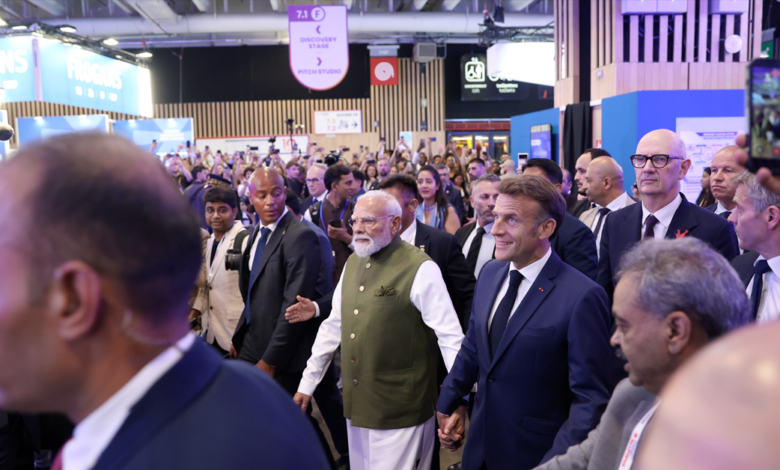
India, finally, was moving to its own logic. The Indian pavilion’s presence and Narendra Modi’s remarks highlighted a strategy built around public digital infrastructure. Where the United States favors private platforms and China leans on its industrial might, India is building systems meant to serve hundreds of millions of users in financial services, government administration, and healthcare.
Each is playing a different part of the same game.
After four days of talks, demos, and meetings, one conclusion stands out: VivaTech 2026 looked less like a showcase of innovation than a snapshot of the world’s new technological power dynamics.
And that’s probably what made it the most interesting edition since the event began.
By the way, kudos to Maurice Levy and his teams.