
Can Europe become the world’s third semiconductor power?
To contact us: editorial@fw.media

A handful of factories in Taiwan currently produces the world’s most advanced chips. These components power artificial intelligence data centres, smartphones, telecommunications networks, Western weapons systems and a growing share of the global economy.
This industrial concentration has become one of the leading strategic concerns for the world’s major powers. Washington fears excessive dependence on Taiwan, while Beijing is seeking to build a domestic industry capable of withstanding US sanctions. Brussels, long convinced that globalisation would guarantee access to critical technologies, is now discovering the limits of that approach.
The semiconductor shortage that began in 2020, followed by the artificial intelligence boom, has profoundly changed Europe’s perception of the industry. Chips are no longer regarded merely as electronic components. They have become strategic infrastructure, alongside energy, telecommunications networks and critical resources.
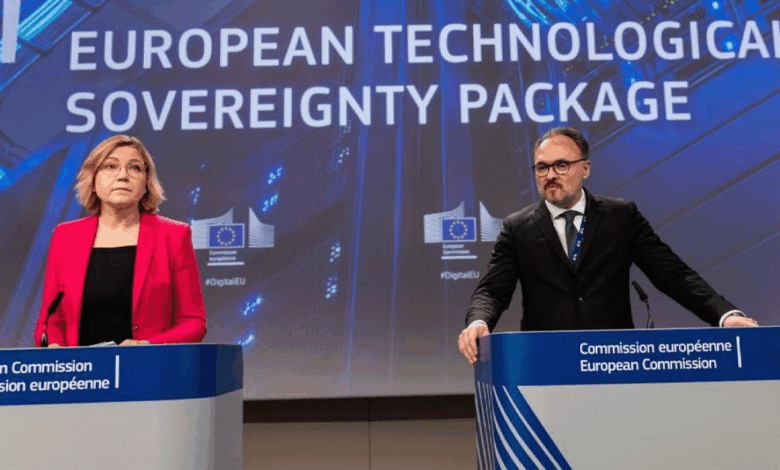
It is against this backdrop that the European Commission is preparing a Chips Act 2.0. Behind the announcements of new factories, state aid and billions of euros in investment lies an ambition to reposition Europe within the industry that will underpin a significant share of economic growth, military power and digital sovereignty over the coming decades. The question now is whether this ambition can be translated into industrial reality.
The new global geography of technological power
Until now, the globalisation of the semiconductor industry has been presented as a model of economic efficiency. The United States designed the most advanced chips. Taiwan and South Korea manufactured them. Japan supplied some of the critical materials. Europe occupied specialised positions in manufacturing equipment and industrial components.
This structure enabled costs to fall continuously while accelerating innovation. It also created an unprecedented level of dependence.
Today, most of the advanced chips used in artificial intelligence infrastructure are manufactured by TSMC in Taiwan. Chip-design software is predominantly American, the most advanced memory chips come from South Korea and a significant share of strategic materials is produced in Asia.
The war in Ukraine demonstrated the consequences of poorly anticipated energy dependence. Tensions between China and the United States have led Western governments to confront another vulnerability: what would happen if access to the most advanced semiconductors were suddenly interrupted?
This question largely explains the simultaneous return of industrial policy in the United States, China, Japan, South Korea and now Europe.
Europe has champions, but it does not control the value chain
Europe’s position is paradoxical. The continent possesses several industrial assets that are unique worldwide, most notably ASML, which holds a near-monopoly in the EUV lithography equipment required to manufacture the most advanced chips. Without its machines, neither TSMC, Samsung nor Intel could produce the processors currently powering artificial intelligence.
Europe can also rely on companies such as STMicroelectronics, Infineon, NXP and Soitec, which occupy leading positions in power semiconductors, automotive components, advanced materials and industrial applications.
This reality sometimes leads European policymakers to argue that Europe is already a semiconductor power. The situation is more nuanced.
The segments currently capturing most of the industry’s economic value include artificial intelligence processors, computing architectures, electronic design automation software, advanced memory, cloud infrastructure and next-generation packaging. These markets are dominated by US and Asian companies.
NVIDIA epitomises this situation. The company has become one of the world’s most valuable businesses without owning manufacturing capacity comparable with TSMC’s. Its power comes from its control of hardware architectures, software and the broader ecosystem surrounding them.
It is precisely in these high-value layers that Europe appears most vulnerable today.
The Chips Act marks the return of European industrial policy
The European Chips Act represents a significant break with the European Union’s recent economic history. For the first time in years, the EU is explicitly pursuing an industrial policy designed to strengthen sectors regarded as strategic. State aid is being mobilised, administrative procedures are being accelerated and public funding is being used to attract manufacturing capacity considered essential to the continent’s economic sovereignty.
The first results are beginning to emerge. In Dresden, TSMC has agreed to establish its first European factory alongside Bosch, Infineon and NXP. In Crolles, STMicroelectronics and GlobalFoundries are developing a new generation of manufacturing capacity. In Italy, STMicroelectronics is investing in silicon carbide, a technology expected to play a central role in electric vehicles and energy infrastructure.
According to the European Commission, projects already approved represent more than €31 billion in public and private investment.
One component of a broader industrial project
Europe’s objective of accounting for 20% of global semiconductor production is a political indicator. It says little, however, about the position the continent will actually occupy in tomorrow’s global technology hierarchy.
The real question is not how many chips will be produced in Europe, but which parts of the value chain the continent will genuinely control. The United States dominates computing architectures, software, hyperscalers and much of the artificial intelligence ecosystem. Taiwan controls advanced manufacturing. China is investing heavily in an integrated industry spanning components through to applications.
For Europe, semiconductors are no longer an isolated industrial sector. They are becoming one component of a broader strategy to rebuild the technological infrastructure that will determine the continent’s competitiveness over the coming decades.
The Chips Act 2.0 is therefore part of a policy agenda that also includes AI Factories, investments in data centres and cloud infrastructure, the development of European artificial intelligence models, industrial data initiatives, high-performance computing, quantum technologies and defence technology.
These issues are often addressed separately. In reality, they are part of the same industrial equation. Semiconductors power computing centres. Computing centres train models. Models process data. Artificial intelligence applications create the demand that justifies further investment in infrastructure.
Europe therefore faces two risks. The first would be to fight the previous battle rather than the next by concentrating its efforts solely on manufacturing capacity. The second would be to treat each issue as a separate policy area when they have become different layers of the same technological system.
The question raised by the Chips Act extends far beyond the semiconductor industry. It concerns Europe’s ability to coordinate all the investments required to build a complete artificial intelligence value chain, from chips to a new generation of industrial applications, particularly in robotics, automation and physical AI.
Ultimately, Europe’s ambition is no longer simply to produce more chips. It is to regain the capacity to act in the technologies that will shape the next phase of the global economy.